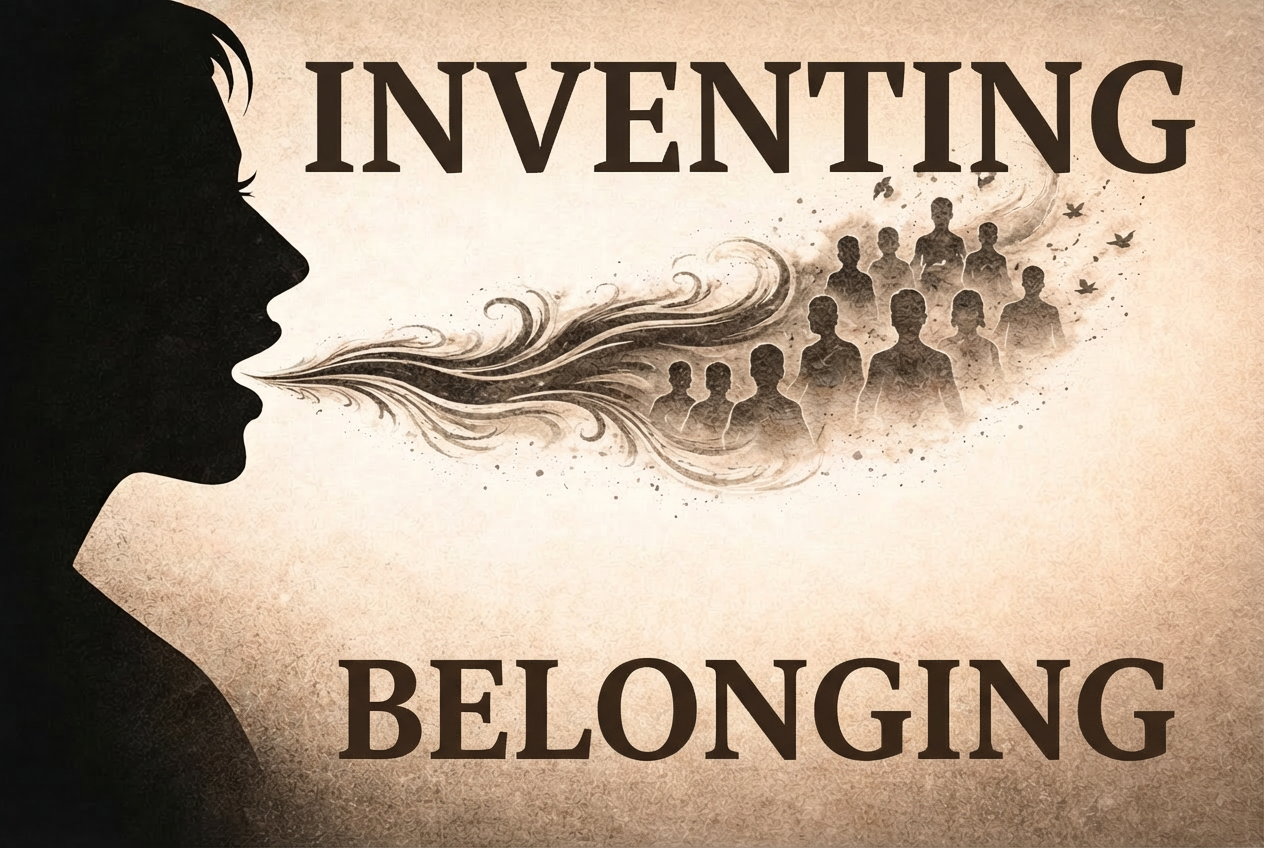
From as far back as I can remember, music wasn’t just something I heard—it was the world I escaped into, the universe where I felt most like myself. It became a private fantasy landscape, a place where the ordinary rules of my life didn’t apply. I could spend hours with melodies looping through my mind, singing entire songs quietly to myself, building drum grooves with my mouth and layering imaginary synth riffs until it felt like I was conducting an invisible orchestra only I could hear.
Part of what deepened that escape was my adoption. Growing up, I often felt slightly out of place, as if there were pieces of me scattered in different lives, never fully aligned. I carried a quiet insecurity, a feeling of being a little less anchored than everyone else. Music became the thing that held me together—the identity I could choose for myself when the rest felt blurry. Fantasy didn’t just entertain me; it made me feel like I mattered, like I could become someone important, someone visible. It gave me permission to step out of my shell and imagine a version of myself that felt whole.
My adopted father helped shape that early sense of musical possibility. He was a multi-instrumentalist who seemed able to coax a tune out of anything—guitar, harmonica, banjo, piano accordion, violin. His world was folk and country, a universe far from the electronic dreamscapes I gravitated toward, but watching him move so naturally between instruments planted a quiet seed in me: music wasn’t just something people consumed; it was something they became. Even in primary school, when I learned the recorder, there was a kind of wonder in simply making sound at all.
And then there was my biological father—someone I did not know yet whose legacy hovered around me. He had played in a band when he was young, a talented singer whose music had drawn my mum into his orbit. Knowing that music existed on both sides of my life—adoptive and biological—made my fantasies feel strangely predestined, as though there had always been a musical thread waiting for me to catch hold of it.
By the time the 80s arrived, electronic music took hold of me like a fever. Human League, new order, Depeche mode, Pet Shop Boys—these artists didn’t just influence me; they defined who I thought I could become. Record shops were my sanctuaries. I’d spend entire afternoons flipping through crates, smelling the cardboard sleeves, tasting possibility in the air. Second-hand stores were treasure troves of 12-inch mixes and extended versions—secret passages into the soundscapes of the producers I worshipped.
Everything intensified in the early to mid-90s, when two close friends opened my mind even further. They pushed electronic music into the centre of our lives. We’d go driving for hours, windows down, speakers rattling with the latest underground tapes, and we’d talk endlessly about how we were going to change the world with music. It was youthful belief—pure, naïve, intoxicating. In those moments, fantasy wasn’t a weakness; it was fuel.
Then, in 1998, I arrived in the UK, and for a moment it felt like my dream was stepping into reality. The underground dance scene overwhelmed me in the best possible way—Ministry of Sound, Turnmills, The Gallery, Trinity at the Chunnel Club. Thursday through Sunday, I lost myself beneath the lights while DJs like Paul Oakenfold, Sasha, Carl Cox, and John 00 Fleming shaped the atmosphere with their sets. I didn’t love every genre—in fact, hard house wasn’t really my thing. But it appealed to many Kiwis living in the city at the time, and as a New Zealander trying to fit in, seeking belonging wherever I could find it, I latched onto it. It wasn’t the music itself that drew me in; it was the opportunity, the community, the sense of finally being part of something.
Still, much of that period was coloured by insecurity. I lied to my fellow Kiwis and antipodean friends about my musical training and DJ skills. I pretended to be more accomplished than I was, building an identity out of bravado and longing. I wanted so desperately to be seen, to matter, to fill the gaps adoption had left in me. DJing felt like the persona that could make me whole.
That mix of passion and delusion followed me when I tried to become a DJ. I imagined myself becoming extraordinary, someone whose name would echo through clubs worldwide. But I was lost in fantasy, swept up in the hedonistic lifestyle surrounding the scene. I chased the image of who I wanted to be rather than the craft itself. The dream never crystallised; it dissolved under the bright lights and long nights.
Yet as I got older, something softened. I found a more grounded version of the dream. I began DJing again—not in superclubs, but at weddings, parties, functions. Places where the music mattered because of what it gave to others, not because of what it said about me. Slowly and patiently, I began to study music properly — sound design, production, remixing — finally building the skills I had once only pretended to have.
Looking back, music was always the thread running through my life—a source of escape, identity, fantasy, and eventually truth. It lifted me, misled me, shaped me, saved me. And while the dreams were sometimes wild or delusional, they kept me moving forward. In the end, fantasy didn’t just distract me—it led me somewhere real.
 The Lies That Made Me: The Invention of Belonging.
Leave a comment